✦ Start here: the quick read
If you've been pricing out an astrocartography reading and a relocation chart and trying to figure out which one you actually need, here's the short answer first: they're not competing methods. They're two zoom levels on the same question, which is what happens to your chart when you stand somewhere else on Earth.
Relocation chart astrology recalculates your entire birth chart for a new city, keeping your exact birth moment but using that city's coordinates. Astrocartography takes the same natal chart and draws, across a world map, the lines where each planet would sit on one of your four angles. One reads a single place in full detail. The other scans the whole map so you can see your options at once. Most people who ask "which do I need" are still scanning, which means the map usually comes first.
If you're brand new to all this, what astrocartography actually is is the foundation, and this article is the comparison: what a relocation chart is, how it differs from astrocartography, how the two actually relate, and a simple rule for which reading fits where you are right now.
What a relocation chart actually is
A relocation chart, sometimes called a relocated chart, takes the exact moment you were born and recalculates the whole chart as if you'd been born at a different location. Same instant in time. Different coordinates. The technique is older than astrocartography and belongs to traditional and modern chart-based astrology rather than to any single founder.
Here's the part that trips most people up, so it's worth stating plainly. A relocation chart does not change who you are or rewrite your natal chart. Your planets stay in exactly the same signs and degrees, and the aspects between them, the conversations the planets are having with each other, stay identical. Those depend on time, and your birth time doesn't change when you move.
What does change is the framing. Two things move when you recalculate for a new place: your angles and your houses. The Ascendant and Midheaven depend on the local horizon and the local meridian, so they shift when the coordinates change. When the angles move, the house cusps move with them, and your planets fall into different houses than they occupy in your birth chart.
That re-housing is the whole point of a relocation chart. A planet that sits quietly in your natal 4th house, the house of home and private life, might land in the 10th house of career and public role when you relocate to a particular city. Same planet, same sign, same aspects, but now it tends to express through a different department of your life. A relocation chart reads that re-shuffle in full, house by house, for one specific place.
What astrocartography actually is, briefly
If you arrived here from the relocation keyword and astrocartography is the less familiar term, here's the compressed version. Astrocartography plots your natal chart onto a world map and draws lines where each of your planets would be angular, meaning sitting right on one of the four chart angles, the MC, IC, ASC, and DSC. It's the system Jim Lewis built in the 1970s and trademarked as AstroCartoGraphy. It's also distinct from local space astrology, which draws directional lines radiating out from a single location rather than mapping angularity across the globe. That's a different technique again, and not the one we're comparing here.
Each line marks where a planet's energy tends to come forward most strongly. A Venus line tends to amplify ease and connection along its path; a Saturn line tends to amplify structure and weight. The lines are mathematically reproducible, the same for any practitioner reading the same birth data. For the full treatment, how to read your astrocartography chart walks through all the lines and what each one tends to amplify. The reason it matters here is what comes next: those lines and relocation charts are built from the same machinery.
A map and a local report
Here's the frame that makes the whole "vs" question dissolve. An astrocartography line is the world-map view of a single relocation fact.
Think about what an astrocartography line really marks. Your Sun MC line is the meridian, the north-south line on the map, running through every place where the Sun would land exactly on your Midheaven if you relocated your chart to that spot. The line is just the global trace of one angular relationship. Stand anywhere on your Sun MC line, pull a relocation chart for that exact city, and you'll find the Sun sitting on the Midheaven. The astrocartography line and the relocation chart are describing the same event from two distances.
So the two techniques aren't competing, they're complementary zoom levels on the same relocated chart. Astrocartography is the map: it scans the entire globe and shows you, at a glance, which planetary themes tend to surface where. A relocation chart is the local report: it zooms all the way into one city and reads the full house-by-house picture, including everything astrocartography's angle lines don't show you on their own.
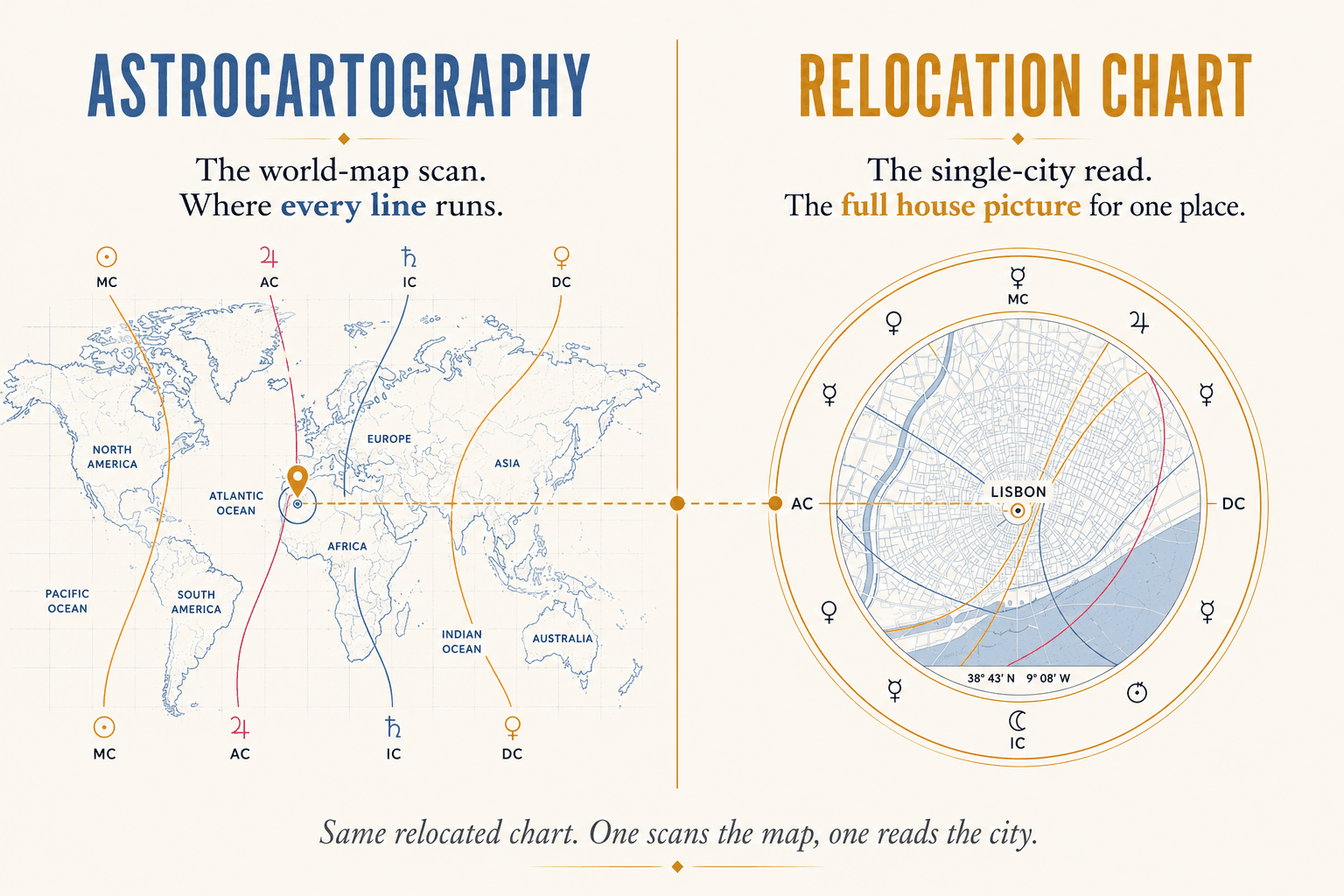
That's also why practitioners tend to use them in sequence rather than choosing between them. You scan with astrocartography to find the handful of places worth taking seriously, then you pull a relocation chart for the one or two you're genuinely considering. Map first, then local report.
Which one do you actually need?
Now the question the title promises. Most of the time, the answer comes down to where you are in the decision.
If you're still comparing places, start with astrocartography. You're asking "where should I even consider?" or "which of these three cities tends to suit me?" That's a scanning question, and astrocartography is the scanning tool. It surveys the whole map at once and surfaces the places where your strongest lines run, which is exactly what you need before you can sensibly narrow down. This is most people, and it's why a Compare Cities reading is the practical next step for the majority of readers: it reads your lines across the cities you're actually weighing.
If you've already committed to one or two places, a relocation chart is the deeper pass. You've moved, or you're certain you're moving, and now you want the full picture of how your chart re-expresses in that one city, not just which lines run nearby but the whole house redistribution. That's a single-location question, and the relocation chart is the single-location tool.
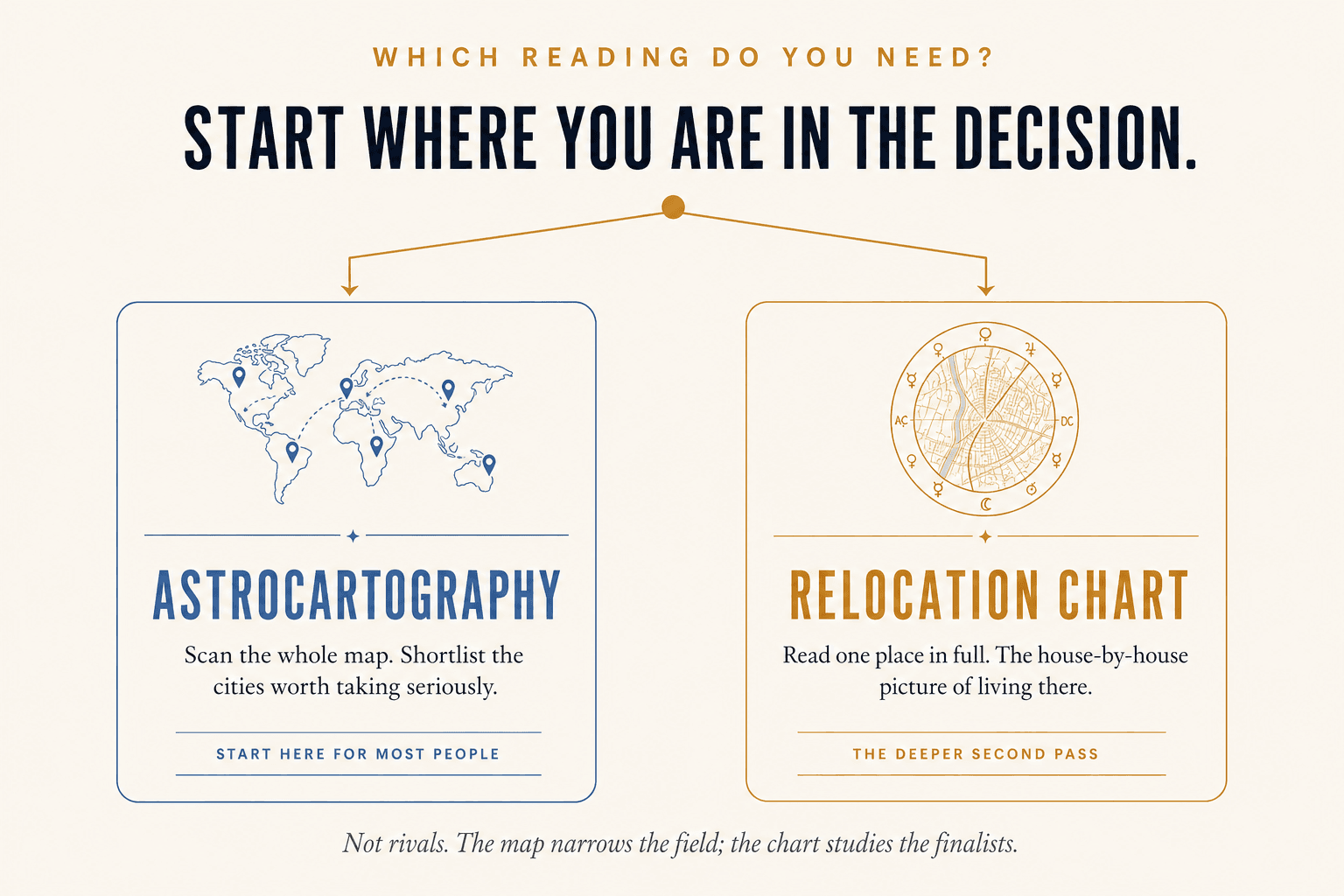
None of this means the two techniques rank against each other. They answer different questions. The map tells you where to look. The local report tells you what you'll find when you get there. For a fuller framework on weighing your lines against the rest of real life, using astrocartography to choose where to live goes deeper on the decision itself.
Common misconceptions
A few misreads come up constantly, and clearing them up tends to make the choice obvious.
"A relocation chart changes my natal chart." It doesn't. It re-houses the same natal planets for a new location. Your signs, your degrees, and your aspects are fixed at birth and stay exactly as they are. The chart is recalculated, not rewritten.
"Astrocartography and a relocation chart are the same thing." They're the same machinery at different zoom levels. Astrocartography is the global map of where your planets are angular; a relocation chart is the full chart for one of those points. Calling them identical misses that one scans and one studies.
"I have to pick one." You don't, and you usually shouldn't. They're built to work in sequence, the map to shortlist and the local report to go deep. Picking one only matters when you're deciding where to spend a single reading, and then it comes down to whether you're still scanning or already committed.
"Moving to a good line guarantees the outcome." It doesn't. A line tends to amplify a theme; it doesn't override your circumstances, your effort, or the ordinary facts of a place. Astrocartography is one input among many, which is the honest frame whether you're reading a map or a relocation chart. If that distinction interests you, an honest look at whether astrocartography is real sits with it directly.
How to get each one yourself
You can see the raw version of both for free before you ever pay for an interpretation. For astrocartography, Astro.com and AstroSeek both generate a free astrocartography map from your birth data, and our free astrocartography cheatsheet walks you through what the lines mean and the orb to keep in mind when you read them. For a relocation chart, the same free chart sites will recalculate your wheel for a new city if you enter that city as the location, though the house interpretation is where a practitioner tends to earn their keep, because reading a re-housed chart well takes more than spotting which planet moved where.
In practice, if you're still deciding between places, the map is the more useful first spend, because it's the only one of the two that compares cities at all.
Get the order right and they stop competing
Astrocartography and a relocation chart aren't rival products you have to choose between. They're two views of the same relocated chart: the world map that scans your options and the local report that reads one city in full. If you're comparing places, you want the scan first. If you've already committed to a city, the relocation chart goes deeper. Get the order right and they stop competing and start doing the two different jobs they're each built for.
With care, Victor