✦ Start here: the quick read
Astrocartography is a branch of astrology that maps your natal chart onto the surface of the Earth. The result is a map showing where each planet's symbolic energy tends to express most strongly across the globe. People use it to think about where to live, where to travel, and where to grow.
If you've ever felt instantly at home in a city you barely knew, or strangely drained in a place that looked perfect on paper, this is one of the few tools that takes that feeling seriously. Without dismissing it as coincidence. And without overclaiming that the stars decided your fate.
This guide walks you through what astrocartography actually is, where it came from, how to read your own map, and just as importantly, what it can't do. By the end, you'll have a clear mental model of the system and a sense of whether it's worth integrating into the decisions you're already trying to make.
What astrocartography actually is
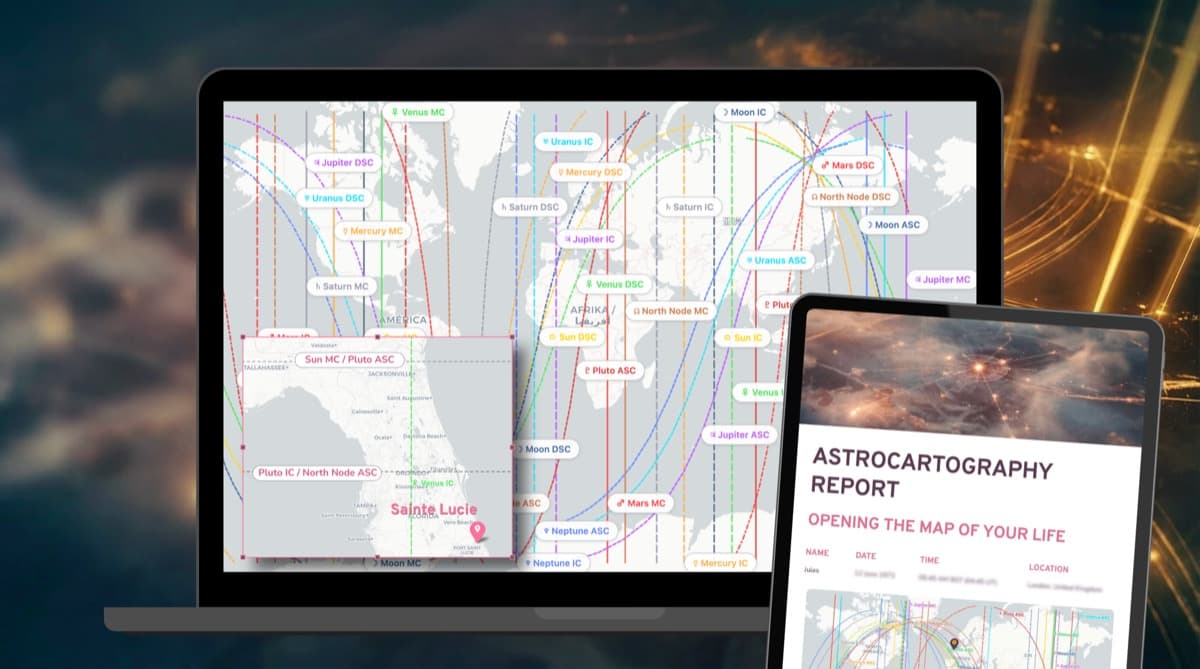
The simplest way to describe it: astrocartography takes the chart that was cast for the moment and place of your birth, and asks where on Earth those same planetary energies would have been most active. Each planet projects four lines across the globe, one for each of the four chart angles. Where those lines fall is what the map shows you.
If that already sounds technical, don't worry. The math is the boring part. The interesting part is that you end up with a map of around forty lines drawn across the planet, each one representing a place where one specific planet meets one specific angle of your chart.
Some of those lines pass near places you've already lived. Some pass near places you've been curious about for reasons you can't quite name. Some pass through cities you'll never go to. All of that is information.
Projecting your chart onto the Earth
Your natal chart is a snapshot of the sky at the exact moment you were born. It shows the position of the Sun, the Moon, and every planet from your specific birth location, in your specific second.
Astrocartography takes that snapshot and asks a different question. Instead of what does this chart say about who you are, it asks: where on Earth would this exact configuration have been overhead, or rising, or setting, at that exact moment?
The answer to that question, repeated for each planet, traces a line across the surface of the Earth. Multiply by ten planets and four chart angles, and you get your astrocartography map.
The four angles
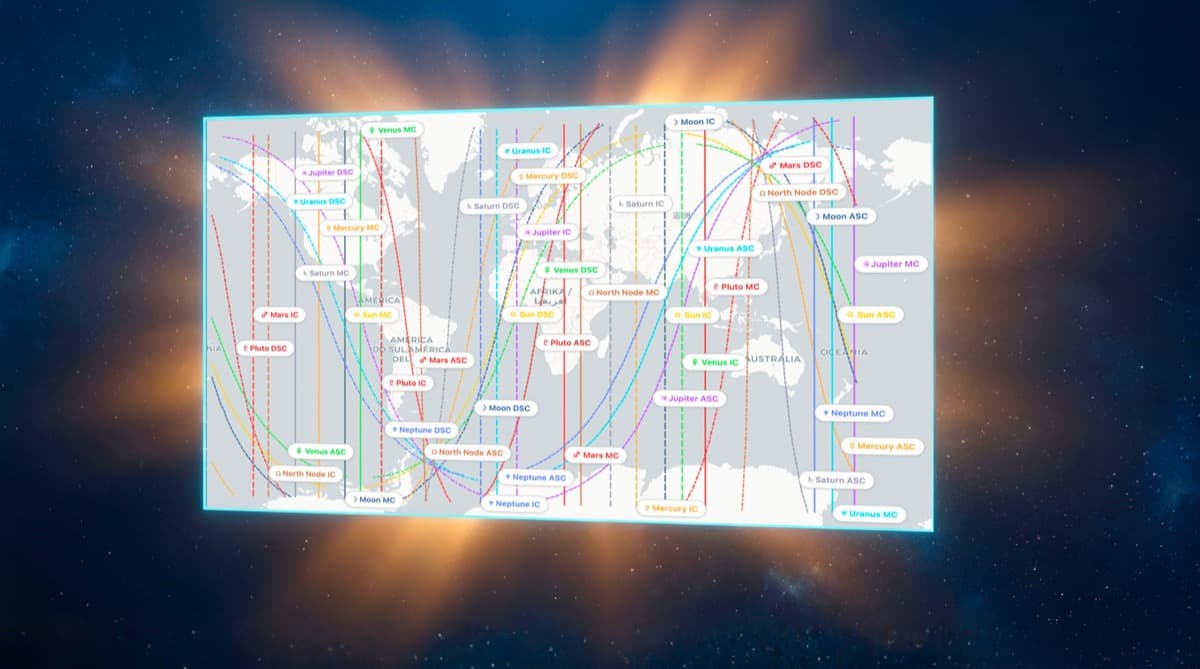
When astrologers say "angle," they mean four specific points in any chart. Each planet creates four lines on your map, one for each angle:
Your public life and career direction. The MC marks where a planet was at its highest point. Locations near an MC line tend to bring that planet's themes into your career and sense of purpose.
Your inner world and emotional foundation. The IC marks where a planet was at its deepest point below the horizon. Locations near an IC line tend to bring that planet's themes into your home life and sense of belonging.
Your identity and self-expression. The ASC marks where a planet was rising on the eastern horizon. Locations near an ASC line tend to amplify that planet's influence on your personality and how others perceive you.
Your relationships and partnerships. The DSC marks where a planet was setting on the western horizon. Locations near a DSC line tend to bring that planet's themes into your partnerships and significant relationships.
Every planet meets each of these four angles at a different point on the Earth's surface. That's how you end up with around forty lines on your map: ten planets, four angles each.
The planetary lines
Each planet contributes its own symbolic register, and that register stays consistent across all four of its lines:
Tends to soften places into ease, beauty, and connection.
Tends to add weight, structure, or testing.
Tends to expand. Opportunity, growth, sometimes excess.
Tends to transform, sometimes uncomfortably. Deep change, power, intensity.
A note on the language. I keep saying "tends to" because that's the honest framing. These are interpretive tendencies, not guarantees. A Venus line in a city doesn't promise that you'll fall in love there. It suggests that the conditions for ease and connection are more available to you in that place than in places where you don't have a Venus line. That's a real difference, but it's a different thing than prediction.
Where the system came from
The version of astrocartography most practitioners use today, including the readings I do, was developed by an American astrologer named Jim Lewis in the 1970s. Lewis didn't invent relocation astrology from scratch. The idea that where you are affects how your chart expresses had been around in different forms for centuries.
What he did was take the projection technique, clean it up, formalize it, and create the first reliable way to map planetary lines across the surface of the Earth in a way anyone could read.
He trademarked the term Astro*Carto*Graphy and spent the rest of his career teaching practitioners how to read these maps for travel, relocation, and life-chapter decisions. He died in 1995, but his framework is still the foundation that nearly every modern astrocartography practitioner builds on.
When you look at a clean astrocartography map with planetary lines projected across the globe, you're looking at his contribution. I think about that often when I work with clients. The maps I draw are a direct continuation of the work he started.

Astrocartography doesn't make decisions for you. It just makes the decisions you're already making a little less blind.
How to read your astrocartography map: what to look for
Once you have your map in front of you, the temptation is to try to memorize every line. Don't. Most of what's on a typical astrocartography map isn't relevant to your actual life right now. The work is noticing which lines actually run through the places that matter to you.
Start with what's geographically possible. The planet lines that don't cross any city you'd realistically live in are not the ones to focus on first. If you've never been to South America and have no plans to go, the Sun line that runs through Peru is interesting but not actionable. Save it for later.
Look at the lines that cross places you've actually been. Places you're seriously considering. Places you're emotionally pulled toward for reasons you can't quite explain. From there, three things matter: which planet, which angle, and how close the line runs to the city in question.
Identifying your important lines
The strongest signal on an astrocartography map isn't usually a single line. It's an intersection of two or three lines that fall close together within a tight latitude band. A single Venus line passing within a few hundred kilometers of a city is meaningful. A Venus line crossing a Jupiter line crossing a city you've been quietly considering for months is something else entirely. That's where astrocartography starts to feel less like horoscope content and more like a real signal worth paying attention to.
I read recently for a client who had a tight Venus-Jupiter cluster running through a mid-sized European city she'd visited once, years ago, for a long weekend. She'd never seriously considered moving there. After we talked through what the cluster meant, and how she actually felt the few days she'd been there, she started planning a three-month stay. I'm not claiming the map made the decision for her. She made it. The map just helped her see what was already true about the place.
Pay attention to the angle, too. A planet on the Midheaven of a place tells you something different than the same planet on the IC. Saturn on the MC of a city might mean you're going to work hard there in a way that builds something over years. Saturn on the IC of the same city might mean the place itself feels heavy, like home is hard there. Same planet, different angle, different felt experience.
What "important" means: orb, distance, and clusters
The technical word for "how close" a line is to a place is orb. It's a measure of distance from the line to the city, expressed in kilometers. The closer the orb, the stronger the line's influence on that place. Most practitioners pay attention to lines within roughly 700 kilometers, though some go tighter and some go wider.
The other thing that matters is whether multiple lines are close together. A single line at 500 kilometers is interesting. Two lines at 500 kilometers each, in the same general region, is significant. Three lines clustered close to a single city is the kind of pattern that earns its own conversation.
A quick word on parans
There's one more thing worth knowing about, though it deserves its own deeper article later. Parans are latitude-based intersections where two planetary lines cross at the same latitude on Earth, creating a band where both planets influence places along that whole line of latitude, even far from the original line crossings. That's a simplification. The technical definition involves angular relationships between two planets at a specific latitude, and we'll unpack the full mechanics in a dedicated piece on parans. For readers who want to go deeper in the meantime, Bernadette Brady's work is the standard modern reference on the subject. Parans are advanced reading and not every practitioner uses them. But if you ever see a reference to parans in your map and want to dig in, that's what they are.
What astrocartography is NOT
This is the section that earns the rest of the article.
But first: is astrocartography real? If you mean "is it a measurable scientific phenomenon with a controlled accuracy rate," then no. If you mean "is it a symbolic system that working practitioners use to ask better questions about place," then yes. This section draws that line.
Astrocartography is not a horoscope. It won't tell you that Mercury is in retrograde and your communication will suffer this week. That's a different kind of astrology entirely.
It's not a prediction of your future. It can't tell you whether you'll be happy in Lisbon or whether your business will succeed in Berlin. Predictions about emotional outcomes depend on far more than where the planets meet the angles of your chart.
It's not a substitute for thinking carefully about visa requirements, climate, finances, relationships, or any of the practical realities that decide whether a city actually works for you. Astrocartography is one input among many. It belongs in the same conversation as those other inputs, not above them.
It's also not the same as some related practices that often get conflated with it. Relocation astrology is a broader practice that includes recasting your entire chart for a new birth location, not just looking at where the planet lines fall. Local space astrology uses a different mathematical projection entirely. These are interesting practices in their own right, but they aren't astrocartography. When someone says "astrocartography," they specifically mean the line-based map system Jim Lewis built.
And maybe the most important thing. Astrocartography won't tell you whether you'll be happy in a place. It will tell you what kinds of energies tend to come up there. Whether those energies are what you're trying to invite into your life right now is a question only you can answer.
Common ways people work with astrocartography
Most of the people who come to me for a reading are in one of three situations.

The first group is considering a move. They're sitting with a possibility, maybe a job offer in a new city, maybe a long-distance relationship that's becoming a real conversation, maybe just a feeling that the place they live isn't where they're supposed to be. They want to know what their chart would say about the cities they're weighing. That's most of what relocation astrocartography is about, and it's what I cover in detail in how to use astrocartography to choose where to live.
The second group is planning a trip. They're not relocating, but they want to go somewhere meaningful, somewhere that aligns with what they're trying to feel or experience. A retreat, a sabbatical, a deliberate week off. Travel astrocartography is lower-stakes than relocation, but it can be surprisingly useful for choosing where to go and when.
The third group is trying to understand something that already happened. They lived in a city for two years and felt drained the entire time, or they spent a summer somewhere and felt completely themselves for the first time, and they want to know what their map says about why. This is one of the quieter uses of astrocartography, but it's often the most clarifying. The map doesn't change anything that already happened, but it can give you language for an experience you didn't have words for.
If you fall into any of those three groups, the rest of this guide is the foundation. The next two articles in this series go deeper on the specific use cases.
How to begin if you're curious
If you want to see your own map, you can pull one for free. AstroSeek and AstroDienst are the two I'd point you to. Both run on the Swiss Ephemeris, the standard chart-calculation engine in contemporary astrology, so the positions you see are the same ones I work from. Input your birth data and you'll have a map within minutes. That's the right place to start. Look at where your lines fall, notice which planets cross places you've been or places you're curious about, and let the patterns settle for a few days before you draw any conclusions.
If what you find on a free tool starts to feel like it matters, that's the moment a practitioner-led reading earns its place. A reading takes the same map and walks you through what the lines actually mean for your specific chart, your specific moment, and the specific question you're trying to answer. If you want to see your own lines drawn for you, that's exactly what our personalized astrocartography reading is for. We'll find the cities where your chart says you're most likely to thrive.
The free tools are fine for exploration. The reading is where the patterns become a real plan.
Whatever you do with your map, take your time with it. The best astrocartography reading is the one you get to sit with long enough for the patterns to make sense against the rest of your life.
With warmth, Jules