✦ Start here: the quick read
If you're new to astrocartography, what astrocartography is and how it works is the place to start. If you already know the basics and want a refresher on reading your chart, how to read your astrocartography chart walks you through the full process.
This article is for a different moment. You've looked at your map. You've seen the lines. And now you're asking: can this actually help me figure out where to live?
The honest answer is yes, but not the way most people expect.
Astrocartography is one input, not the answer
Here's the part most astrocartography content online skips over: your map is not a decision engine. It doesn't rank cities. It doesn't tell you where you'll be happy. It doesn't account for visa requirements, cost of living, how far you'd be from your family, or whether you'd actually enjoy the weather in Lisbon for more than a two-week holiday.
What astrocartography does offer is a layer of insight that's genuinely hard to get anywhere else. It can show you how a place is likely to interact with your specific chart: what energies tend to activate there, what themes are likely to surface, and what kind of life chapter that location tends to support.
That's useful. But it's one input among many.
That's the approach this article takes, too. It treats astrocartography as what it is: a powerful symbolic tool that belongs in the conversation alongside finances, relationships, career logistics, and your own gut feeling. Not above them.
What your astrocartography map can actually tell you
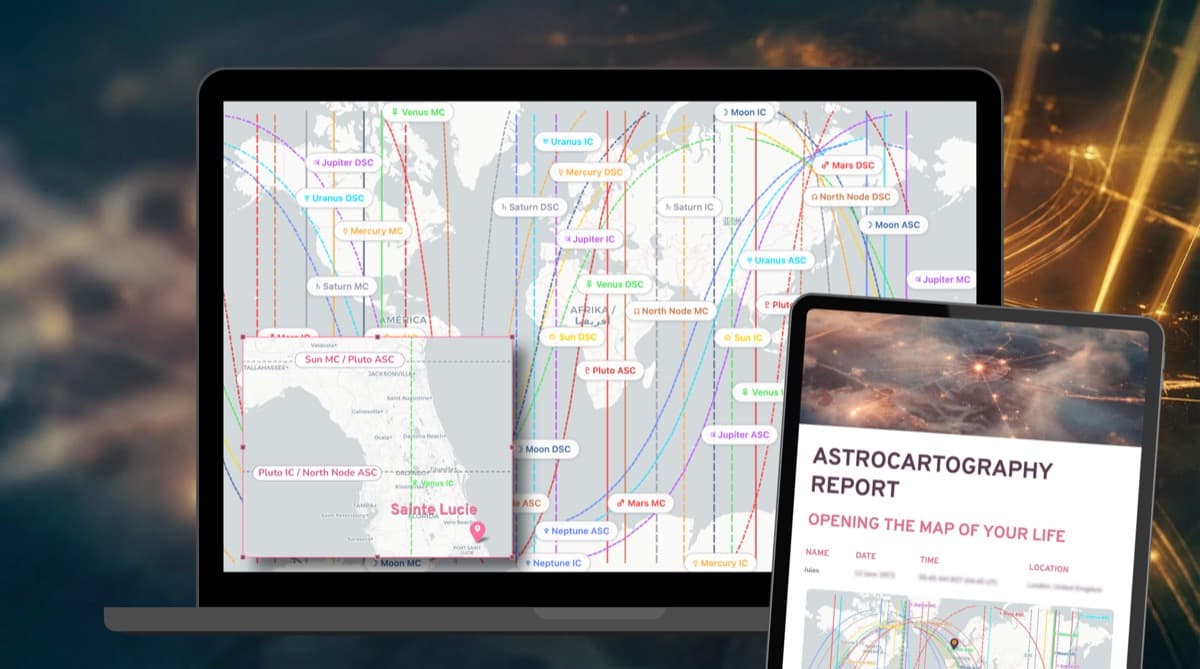
Astrocartography, the line-based mapping system Jim Lewis developed in the 1970s, projects your natal chart onto the globe. Each of the 10 major planetary lines (Sun through Pluto) crosses the Earth on four angles (MC, IC, ASC, DSC), creating 40 distinct lines. When you look at that map for relocation, you're looking for three things:
1. What a place tends to bring up for you. Each planetary line carries a different energy signature. A Venus line through Barcelona doesn't mean you'll fall in love there. It means that the Venus themes in your chart (beauty, connection, ease, pleasure) tend to be more active in that geography. The experience is specific to your chart, not universal.
2. What kind of life chapter a place tends to support. This is where the distinction between ease lines and growth lines matters most (more on this below). Some locations tend to feel smooth. Others tend to feel challenging in productive ways. Neither is inherently better. It depends on what you need right now.
3. Where multiple energies converge. Single lines are signals. Clusters of lines are stronger signals. If your Venus, Jupiter, and Moon lines all pass within a few degrees of a city, that's a place where multiple supportive themes converge. In 500+ combined readings, I've found these convergence zones tend to produce the most consistent, recognizable effects.
What astrocartography cannot tell you
Astrocartography cannot tell you whether you'll be happy somewhere. Happiness is too complex, too dependent on relationships, health, purpose, and daily habits. A Venus IC line through a city doesn't guarantee contentment. It suggests certain themes tend to show up there.
It cannot tell you whether a specific life event will happen. "Will I meet someone in Paris?" is not a question astrocartography answers. "What themes tend to activate for me in Paris?" is.
It cannot replace the practical realities of relocation. Immigration law, housing costs, language barriers, distance from your support network: these factors shape your daily experience far more than any planetary line. A Saturn MC line doesn't override a visa rejection.
The readers who use astrocartography most wisely are the ones who hold it alongside everything else, not instead of it.
So what can you do with your map when relocation is on the table? Here's the practical approach.
How to actually read your map for relocation
If you've already read your astrocartography chart, you know how to pull up your map on AstroSeek or Astro.com and identify your lines. For relocation, the approach shifts from general exploration to focused comparison.
Start with your shortlist
Don't try to scan the entire globe for "the best place." Start with 2 or 3 cities you're already considering, places where you have a reason to move beyond the astrology. Then look at what lines run near each one.
Look for clusters, not single lines
A single Jupiter MC line through a city is a signal worth noting. But a cluster of Jupiter MC, Venus DSC, and Moon IC lines all within 3-4 degrees of the same city is a much stronger indication that the place is likely to resonate with multiple dimensions of your life.
This is where the concept of orb matters. In astrocartography, orb is how far (in degrees of longitude) you are from the exact line. Most practitioners consider anything within about 4-5 degrees to be within effective range, with the influence tending to be strongest at the exact crossing and fading as you move further away.
Distinguish growth lines from ease lines

This distinction is one of the most important concepts in relocation astrocartography, and it's the one most online content gets wrong.
Ease lines (Venus, Jupiter, Moon) tend to produce experiences that feel smooth, supportive, and naturally aligned. Venus IC tends to bring a sense of home and beauty. Jupiter MC tends to bring visibility and professional expansion. Moon lines tend to bring emotional comfort and a feeling of belonging.
Growth lines (Saturn, Pluto, and sometimes Mars) tend to produce experiences that feel challenging, intense, or restructuring. Saturn MC tends to push you into greater discipline and responsibility. Pluto IC tends to bring deep transformation of your private life. Neptune and Uranus lines are harder to categorize: Neptune tends to dissolve boundaries (which can feel either spiritual or disorienting), and Uranus tends to bring sudden change (which can feel either liberating or destabilizing). These aren't "bad" lines. They're lines that tend to demand something from you.
The question isn't "which type is better?" It's "which type serves the life chapter you're entering?"
If you're burned out and need restoration, a Venus or Jupiter cluster is probably more aligned. If you're stagnating and need disruption, a Saturn or Pluto line might be exactly the catalyst you need. Neither type is inherently better. The right answer depends entirely on where you are in your life.
Five questions to ask yourself before you decide
Astrocartography gives you symbolic insight. These questions help you integrate it with everything else.

1. What am I optimizing for right now? Career growth, emotional peace, creative expression, romantic partnership, financial stability? Your answer shapes which planetary lines matter most. Venus and Jupiter lines serve ease and expansion. Saturn and Mars lines serve ambition and discipline.
2. Am I looking for ease or growth? Be honest. Some people say they want peace but actually need challenge. Some people think they need a fresh start but actually need stability. Your astrocartography map can support either, but only if you know which one you're actually seeking.
3. Can I realistically move there? Most readers' strongest lines run through places they can't easily move to. That's normal. If your Venus IC crosses through rural Argentina and you don't speak Spanish, don't have a visa path, and work remotely in a timezone-sensitive role, the line is still symbolically meaningful. You might visit. You might explore what Venus IC themes mean for you and look for those qualities in places that are actually accessible.
4. What does my life look like there beyond the astrology? Do you know anyone in that city? Can you afford it? Do you speak the language? Is the climate something you'd actually enjoy for years, not just on vacation? These factors will shape your daily life far more than any line on your map.
5. Have I spent time there? If you can, visit before you commit. A two-week stay under your Venus line is the best field test astrocartography offers. You'll feel the difference between what the chart says and how the place actually lands in your body.
When reading your own map isn't enough
A free astrocartography chart on AstroSeek or Astro.com is a genuinely useful starting point. You can see your lines, identify clusters, and get a general sense of how different regions interact with your chart.
But for major relocation decisions, doing it yourself has real limits.
Free tools like AstroSeek and Astro.com (both powered by the Swiss Ephemeris for calculation accuracy) show you the 10 main planetary lines on the four angles. That's 40 lines total, plus the North Node on some tools. But they don't show you paran lines: latitude-based crossings where two planetary energies activate at the same point on Earth. Astrologer Bernadette Brady's work on parans is the most referenced in the field, and these crossings often explain why a place feels a certain way even when no obvious planetary line runs directly through it. Parans are a second layer that most free tools don't surface at all (professional software like Solar Fire does).
Free tools also don't weigh the lines against each other. Your Jupiter MC line and your Saturn IC line might both pass through the same city. Which one is likely to be more dominant? That depends on your full natal chart, the orb of each line, and how the planetary dignities interact. These are practitioner-level judgment calls that a static map can't make.
Honestly, the moment when a professional reading tends to be most valuable is when you're down to 2 or 3 cities and you need to understand the trade-offs between them. That's the kind of comparison that benefits from a trained eye.
A relocation chart reading, which recalculates your birth chart for a specific city to show how your life reorganizes there, can offer even more depth. It's a different technique from astrocartography, focused on one city at a time rather than a global overview. Some practitioners (including us) offer both, because the two approaches are complementary.
If you want to start with our free guide to reading your astrocartography map, that's a solid next step. It covers all 40 line combinations and gives you a framework for reading your chart on your own.
With warmth, Jules